Module 10 — Cost Optimization & Economics
Time: 2–3 days · Depends on: 01, 05, 07 · Next: Single agents
Fictional teaching scenario.
Finance screenshots a 40% token drop after “routing everything to mini.” Leadership celebrates thrift. Support reopen rate doubles. The mini model fails validators, retries three times, then escalates to humans who eat the savings. cost_per_success barely moved — sometimes rose. Separately, a cache keyed only on user text serves Alice Bob’s invoice answer. Tokens were never the product. Successful outcomes under a budget were.
Case question: Can you lower cost per successful outcome without raising reopen rate, leaking cached data, or hiding failure behind a cheaper average?
Learning objectives
- Define and track unit economics:
cost_per_success, not raw token thrift - Identify the real token and call drivers in a request path
- Apply routing, caching, and prompt compression without silent quality collapse
- Implement a usage ledger and budget gates before traffic scales
- Read provider bills in terms of architecture choices you control
LLM spend is not a fixed SaaS seat license. It is closer to pay-per-request compute with a heavy tail: one agent loop or RAG dump can cost 100× a classifier call.
If you only watch “total tokens this month”:
- You cut the model that was carrying hard cases and quality collapses
- You cache the wrong key and serve stale personalized answers
- You “optimize” prompts while retries and tool thrash dominate the bill
CS framing: treat each product action as a transaction with success criteria, measure $/success, and put admission control (budgets, max steps, cache, routing) in code — the same place you put rate limits and timeouts.
Mental model
flowchart TB
  R[Request] --> G{Budget / ledger OK?}
  G -->|no| X[429 / degrade gracefully]
  G -->|yes| C{Cache hit?}
  C -->|yes| O[Return cached]
  C -->|no| RT[Model router]
  RT --> SLM[Cheap / SLM]
  RT --> FULL[Strong model]
  SLM --> P[Pipeline: retrieve / tools / generate]
  FULL --> P
  P --> V{Success criteria?}
  V -->|fail + escalate| FULL
  V -->|ok| L[Log tokens + $ + outcome]
  L --> LED[Usage ledger]
Optimize the path, not a single hyperparameter. A smaller model that needs 8 retries can lose to one strong call.
Intuition lock
Sticky picture: Optimize cost_per_success, not thrift theater. The router is a triage nurse — cheap path first, escalate when criteria fail. Cache keys must version meaning (model + template + tenant), not just the user’s sentence.
Kill this idea: “Lower tokens / always use the smallest model = winning.” → Replace with: Minimize $ per successful business outcome under quality and latency SLOs; put gates on the hot path.
Core tutorial
1. The unit metric that matters
Also track:
| Metric | Why |
|---|---|
cost_per_request |
Capacity planning |
success_rate |
Denominator health |
tokens_in / tokens_out |
Which side dominates |
cache_hit_rate |
Free wins |
escalation_rate |
Router working? |
p95_latency |
Cost twin (timeouts → retries) |
Wrong objective: minimize tokens.
Right objective: minimize $ per successful business outcome subject to latency and quality SLOs.
Example: support deflection.
- Cheap bot: $0.002/call, 40% resolve → $0.005 per success, many handoffs
- Hybrid: $0.008/call, 85% resolve → ~$0.0094 per success but lower human cost
Include downstream cost (human review, chargebacks) when the product owns them.
Explainer
Unit economics force you to define success in code: JSON schema valid, retrieval Hit, human CSAT, ticket closed without escalate. Without that label, “cost optimization” is just spending less to produce wrong answers faster.
2. Cost drivers (where the money actually goes)
| Driver | What inflates it | Levers |
|---|---|---|
| Input tokens | System + tools + RAG junk + full history | Packing, summaries, better retrieval, shorter tools |
| Output tokens | Verbose prose, CoT, multi-sample | Caps, schemas, “concise”, extractive answers |
| Model tier | Defaulting everything to flagship | Router + escalate on failure |
| Calls / retries | Agents, self-consistency, flaky tools | max_steps, idempotent tools, backoff caps |
| Embeddings | Re-embed whole corpus every deploy | Content-hash; batch; change-only |
| Rerank / tools | External APIs per request | Cache; skip reranking only when a retrieval-confidence rule has been calibrated and validated on a representative labeled evaluation set |
Rule of thumb for chat+RAG: input often dominates. For agents that write code or long plans: output and step count dominate.
Don't skip rerank on raw dense score
Vector similarity is not a calibrated measure of retrieval sufficiency across queries, embedding models, corpora, domains, or query lengths. A high cosine/dot score on one index is not “we already have the right docs” on another.
Skip reranking only when a retrieval-confidence rule has been calibrated and validated on a representative labeled evaluation set.
Production path:
baseline retrieval → labeled eval set → measure first-stage sufficiency → calibrate confidence rule → conditionally skip reranker
Until that rule is measured, pay for the rerank (or accept the quality risk explicitly). The same calibration requirement applies to gating agentic RAG (Module 09).
# Approximate with tiktoken (or your provider’s usage field — prefer the latter in prod)
import tiktoken

def count_tokens(text: str, model: str = "gpt-4o-mini") -> int:
    try:
        enc = tiktoken.encoding_for_model(model)
    except KeyError:
        enc = tiktoken.get_encoding("o200k_base")
    return len(enc.encode(text))
Always log prompt vs completion separately. Average “total tokens” hides a verbose-generator bug.
3. Model routing
Send easy work to a cheap model; escalate hard work.
This course ships ModelRouter in src.cost:
from src.cost import ModelRouter

router = ModelRouter(cheap="gpt-4o-mini", strong="gpt-4o")  # placeholder ids; see Setup
assert router.pick("classify", "short text") == "gpt-4o-mini"
assert router.pick("complex_reason", "x") == "gpt-4o"
assert router.pick("chat", "x" * 9000) == "gpt-4o"  # long context heuristic
Design patterns:
- Task-type route — classify / extract → mini; plan / multi-hop → strong
- Confidence escalate — mini first; if validator fails → strong
- Cascade — rules → SLM → large model → human
- Length / complexity features — input size, tool need, user tier
Don't route on the model's self-reported confidence
A model saying "confidence = 0.93" is not a calibrated signal — LLMs are frequently overconfident and that number isn't grounded in anything measurable. Route on things you can actually verify: deterministic/schema validation, a task classifier, disagreement between two samples or models, or a calibrated router trained and checked against labeled outcomes.
Token-level log probabilities can provide a more grounded model-internal signal than verbal self-confidence, but they should still be calibrated against task outcomes before being used as a production routing threshold. Logprobs are not automatically calibrated probabilities of task correctness.
def answer(task: str, prompt: str, run_model, validate) -> str:
    model = router.pick(task, prompt)
    out = run_model(model, prompt)
    if not validate(out) and model != router.strong:
        out = run_model(router.strong, prompt)
    return out
Think about it
Question: Your router sends 90% of traffic to a mini model. Token bill drops 60%, but cost_per_success barely moves. What happened?
Reveal a strong answer
Success rate likely fell: more retries, more human escalations, or longer sessions. Unit metric uses *successful* tasks in the denominator. Also check whether the remaining 10% on the strong model got heavier (harder mix) or agents started looping. Always pair spend charts with success_rate and escalation_rate.Budgeted test-time compute
A thinking budget is another row on this router, beside cache, a small model, and a human. Some tickets get more tokens to reason. That spend is justified only when three numbers still hold: the golden set moved, the latency cap held, and the dollar cap held. A longer chain of thought that does not move cost_per_success is the same failure as the mini-model route above.
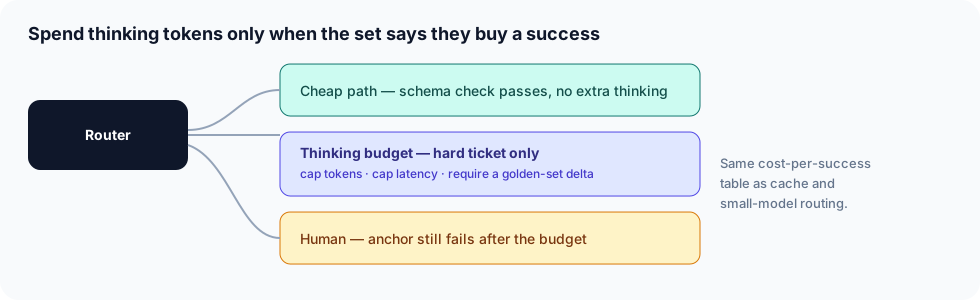
The middle lane is a cap, not a model brand. Easy tickets stay on the cheap path. The human lane remains the last stop when the anchor still fails.
Route into the thinking lane on a signal you can check: schema validation failed, two cheap samples disagreed, or the task type is on the strong list. Do not route into it because the model said it was unsure. Record thinking tokens separately from the answer tokens, or the bill will hide them inside “completion.”
route_thinking in src/cost.py is that row. An easy ticket stays cheap even when a thinking budget would have been justified for a harder one.
def route_thinking(*, schema_ok, samples_disagree, hard_task,
                   golden_delta, within_latency, within_budget) -> str:
    easy = schema_ok and not samples_disagree and not hard_task
    if easy:
        return "cheap"
    justified = golden_delta is not None and golden_delta > 0 and within_latency and within_budget
    if justified:
        return "think"
    return "human"

assert route_thinking(
    schema_ok=True, samples_disagree=False, hard_task=False,
    golden_delta=0.2, within_latency=True, within_budget=True,
) == "cheap"
assert route_thinking(
    schema_ok=True, samples_disagree=True, hard_task=False,
    golden_delta=0.2, within_latency=True, within_budget=True,
) == "think"
assert route_thinking(
    schema_ok=False, samples_disagree=True, hard_task=True,
    golden_delta=0.2, within_latency=True, within_budget=False,
) == "human"
pytest tests/test_cost.py -v covers this lane together with the existing router, cache, and ledger.
4. Caching (with safe keys)
Cache identical expensive work: embeddings of unchanged docs, pure functions, idempotent tool GETs, deterministic classifications.
Choose the cache layer first. The MemoryCache below stores application results. Runtime KV caching reuses attention state during generation; cross-request prefix caching reuses compatible state for identical starting tokens and still generates a fresh answer. Prefix reuse mainly avoids repeated prefill work, so it will not remove the cost of a long output. See vLLM's prefix-caching documentation and the three-cache comparison in Module 28.
Mini-experiment: keep stable instructions first and ticket-specific text afterward, without changing instruction priority. Compare a cold request, a repeated-prefix request, and one with a changed opening prefix. Record actual cached-input usage where exposed, TTFT, output length, quality, and billed cost. Keep cache-miss and cache-hit populations separate; a latency reduction is not proof of a billing discount.
Course MemoryCache (keep this pattern; swap Redis in production):
import hashlib
import time
from typing import Any

class MemoryCache:
    def __init__(self, ttl_s: int = 3600):
        self.ttl_s = ttl_s
        self.store: dict[str, tuple[float, Any]] = {}

    def _key(self, namespace: str, payload: str) -> str:
        h = hashlib.sha256(payload.encode()).hexdigest()
        return f"{namespace}:{h}"

    def get(self, namespace: str, payload: str) -> Any | None:
        k = self._key(namespace, payload)
        item = self.store.get(k)
        if not item:
            return None
        exp, val = item
        if time.time() > exp:
            del self.store[k]
            return None
        return val

    def set(self, namespace: str, payload: str, value: Any) -> None:
        k = self._key(namespace, payload)
        self.store[k] = (time.time() + self.ttl_s, value)
Runnable import:
from src.cost import MemoryCache

cache = MemoryCache(ttl_s=3600)
cache.set("embed:v1", "doc-42 text", [0.1, 0.2])
assert cache.get("embed:v1", "doc-42 text") == [0.1, 0.2]
Key must include:
- Namespace / purpose (
chat:v3,embed:v1) - Model id
- Prompt template version
- Critical params (temperature if non-zero, tools schema hash)
- User/tenant id when output is personalized or sensitive
Do not cache across tenants without isolation. Do not cache high-stakes answers forever without TTL.
Layers:
| Layer | Example |
|---|---|
| Exact response cache | Same hashed prompt → same completion |
| Provider prefix cache | Stable system prompt (where offered) |
| Embedding cache | Content-hash → vector |
| Tool HTTP cache | Idempotent GET with cache headers |
| Retrieval cache | Query hash → chunk ids (short TTL) |
Explainer
A cache key is a claim about equivalence. If two requests hash the same but would produce different correct answers (different tenants, new prompt template, new model, personalized data), the key is a bug. Version the meaning of the generation: namespace:model:template_ver:tenant?:payload_hash. High hit rate with wrong keys is an incident generator with good dashboards.
5. Usage ledgers and spend guardrails
from src.cost import UsageLedger

led = UsageLedger()
led.add("user-42", cost_usd=0.004, tokens=1200)
assert led.allowed("user-42", limit_usd=1.0)
print(led.usage("user-42"))
Pattern in a request handler:
def handle(user_id: str, prompt: str, ledger: UsageLedger, limit: float):
    if not ledger.allowed(user_id, limit):
        raise PermissionError("budget exceeded")
    # ... call model ...
    ledger.add(user_id, cost_usd=estimated, tokens=usage_total)
Pair application ledgers with:
- Provider hard billing limits
- Anomaly alerts (10× baseline rps or $/min)
- Per-feature budgets (agent loops vs autocomplete)
Explainer
A ledger is admission control, not accounting theater. Soft dashboards without allowed() checks do not stop a runaway agent at 3 a.m. Put the gate on the hot path; make “budget exceeded” a first-class, testable branch.
6. Prompt and context economy
Checklist that usually moves the needle:
- Stable system prefix → enable provider prompt caching when available
- Retrieve fewer, better chunks (Module 09) — junk tokens are pure loss
- Summarize long tool outputs before re-feeding the model
- Batch offline classification / extraction jobs
- Prefer structured / extractive answers over essays when product allows
- Cap
max_tokensto what the UI will actually show - Drop full chat transcripts; use rolling summaries (Module 05)
Compression options (increasing risk):
- Better retrieval (best quality retention)
- Summarize history / tools
- Smaller models for substeps
- Aggressive truncation (last resort — measure quality)
7. Agents and tools: the silent bill
Agents multiply cost by steps × tokens_per_step.
Controls:
| Control | Effect |
|---|---|
max_steps |
Hard ceiling |
| Repeated tool-signature abort | Stop thrashing |
| Tool result size limits | Shrink next prompt |
| Cache tool results | Skip duplicate HTTP |
| Plan-then-execute with short plans | Fewer exploratory calls |
Never give an agent an uncapped browse loop in production without a $ budget tied to the ledger.
Think about it
Question: A single-turn chat feature costs ~$0.003 median. The new “research agent” averages $0.18 with the same user question. List three architectural multipliers before you blame the model price list.
Reveal a strong answer
(1) **Step count** — each decide+act is another full prompt with growing scratchpad. (2) **Context growth** — tool dumps re-enter every later step (input tokens dominate). (3) **Retries / thrash** — same search args, failed validators, or multi-sample. Also: always-on strong model, no retrieve cache, no max_steps. Fix path cost before negotiating list prices.8. Estimating cost in tests and CI
Keep a simple estimator for local drills (replace rates with current list prices):
RATES = {  # USD per 1M tokens — update when you read this
    "mini": {"in": 0.15, "out": 0.60},
    "full": {"in": 2.50, "out": 10.00},
}

def estimate_usd(model: str, tokens_in: int, tokens_out: int) -> float:
    r = RATES[model]
    return (tokens_in * r["in"] + tokens_out * r["out"]) / 1_000_000
In production, prefer provider usage fields on the response over local estimates.
Log line shape worth standardizing:
9. Quality gates after savings
Every cost change needs a paired quality check:
- Fix a golden set (Module 04)
- Measure success_rate + cost_per_success before/after
- Promote only if quality ≥ threshold and $ within budget
- Watch p95 latency (timeouts create retries and increase spend)
Savings that fail the gate are regressions, not wins.
Think about it
Question: You add an exact-match response cache keyed only on user text. Hit rate is high. What security/product bugs might you have introduced?
Reveal a strong answer
(1) Cross-user leakage if keys omit tenant/user and two users ask the same question about private data. (2) Stale answers after policy or catalog changes (no TTL / template version). (3) Wrong model/version served after a prompt deploy because template version was not in the key. (4) Caching personalized or time-sensitive outputs (“my last invoice”). Namespace keys by tenant, include model+template version, set TTLs, and exclude sensitive personalized paths.Failure modes
| Symptom | Cause | Fix |
|---|---|---|
| Bill down, tickets up | Optimized $ not $/success | Restore quality gate; fix router |
| Cache high, users confused | Stale or cross-tenant keys | Versioned keys + TTL + isolation |
| Mini model “too expensive” | Retries / long outputs | Cap tokens; fix validators; fewer loops |
| Embedding bill spikes | Full re-embed | Hash + incremental ingest |
| Ledger useless | Not on hot path | allowed() before call |
| Agent 100× cost | No max_steps | Hard stops + repeated-call abort |
Case checkpoint
Opening failure: A cheaper-looking system hid reopen costs and risked sharing cached content across tenants.
What this lab demonstrates: Cost per successful request, a quality-gated router, cache hit rate, and an enforced usage limit test savings against outcomes and hard budgets.
What it does not prove: Fifty requests do not capture traffic seasonality, and cache correctness still depends on complete tenant- and version-aware keys.
Lab
- Log tokens and estimated $ for 50 real or fixture requests on one feature.
- Compute
cost_per_successwith an explicit success predicate. - Route easy traffic through
ModelRouterto a mini/local model; measure quality delta on a 20-case golden set. - Add
MemoryCache(or Redis) for one idempotent subcall; report hit rate. - Enforce
UsageLedger.allowedwith a low test limit; write a unit test that the gate trips.
Stretch: break down $ by stage (retrieve / rerank / generate) for one RAG request.
Quizzes
Quiz · +25 XP
What is the primary optimization target for production LLM features?
Quiz · +25 XP
Which fields belong in a safe LLM response cache key?
Open source materials
| Resource | Use it for |
|---|---|
Course src/cost.py |
ModelRouter, MemoryCache, UsageLedger |
| Provider pricing pages (OpenAI / Anthropic / Google) | Live rates for estimators |
| humanlayer/12-factor-agents | Budgets, owned control flow |
| Langfuse / Phoenix / provider dashboards | Token traces in real traffic |
| mlabonne/llm-course | Deploy/cost-aware engineer path |
Checkpoint
- You know cost per successful task for one real flow
- At least one of: routing, caching, budget cap is implemented
- Quality gate still enforced after savings
- Logs separate prompt vs completion tokens
Mark complete when you can show cost_per_success for one feature and at least one enforced control (router, cache, or ledger gate).
Exercise
- Catalog: EX-10 — Cost controls
- Prove: Router, cache, and ledger actually deny over-budget work.
- Test:
pytest tests/test_cost.py -v
Return to the case: Routing and cache isolation lower cost only when success and reopen rates remain acceptable. A smaller bill is not an optimization if quality or tenant boundaries regress.
Next: Single agents